
New bike review · Mountain Trail
Kawasaki KLX 230
A real trail bike with a number plate, and it asks you to accept the consequences
Ex-showroom
₹3,37,000
On-road (metro)
₹3,92,000
Used 2022-2025
₹2,35,000 - ₹2,95,000
Key takeaways
- Ex-showroom ₹3,37,000, on-road roughly ₹3,92,000 in a metro — budget for that gap, it is tax and insurance, not dealer greed.
- A clean 2022-2025 used example sits at ₹2,35,000–₹2,95,000, and the service book matters more than the odometer.
- Real-world mileage came out at 32-36 kmpl, so work your monthly fuel bill off that number rather than the brochure figure.
- Running cost: servicing rs 2,800-4,200 per service, every 5,000 km, insurance rs 9,000-12,000 a year comprehensive, plus tyres and chain every 20,000–25,000 km.
- Biggest strength: 134 kg kerb weight makes technical trails genuinely approachable. Biggest compromise: 880 mm seat height rules it out for shorter riders.
- Seat height is measured 880 mm and kerb weight 134 kg — sit on it with both feet down before you sign anything.
Why the Kawasaki KLX 230 matters in 2026
The first thing you notice is the weight, or rather the lack of it. At 134 kg you can pick this bike up out of a ditch on your own, which I had to do twice on a trail near Kolad and was quietly grateful for both times. The second thing you notice is the seat height, and if you are under about 5'7" you are going to be tiptoeing at every signal. Those two facts tell you almost everything about who this motorcycle is for.
Let's start with money, because that's what everyone asks me first. It's a mountain trail bike, ₹3,37,000 ex-showroom, and about ₹3,92,000 (roughly ₹3.92 lakh) by the time it's on the road in a metro. That gap is road tax, insurance and dealer charges, and it moves a fair bit between states — Delhi is around 6%, Karnataka nearly 14%. I've seen two friends pay ₹9,000 apart for the same bike in different cities. Ask for the breakup in writing.
Used, a tidy 2022-2025 example usually goes for ₹2,35,000 to ₹2,95,000. What decides where you land in that band isn't the odometer as much as the service book. A single-owner bike with every stamp in place will cost you 10-15% more, and honestly, pay it. The cheap one always turns out to be the expensive one.
Design, build and first impressions
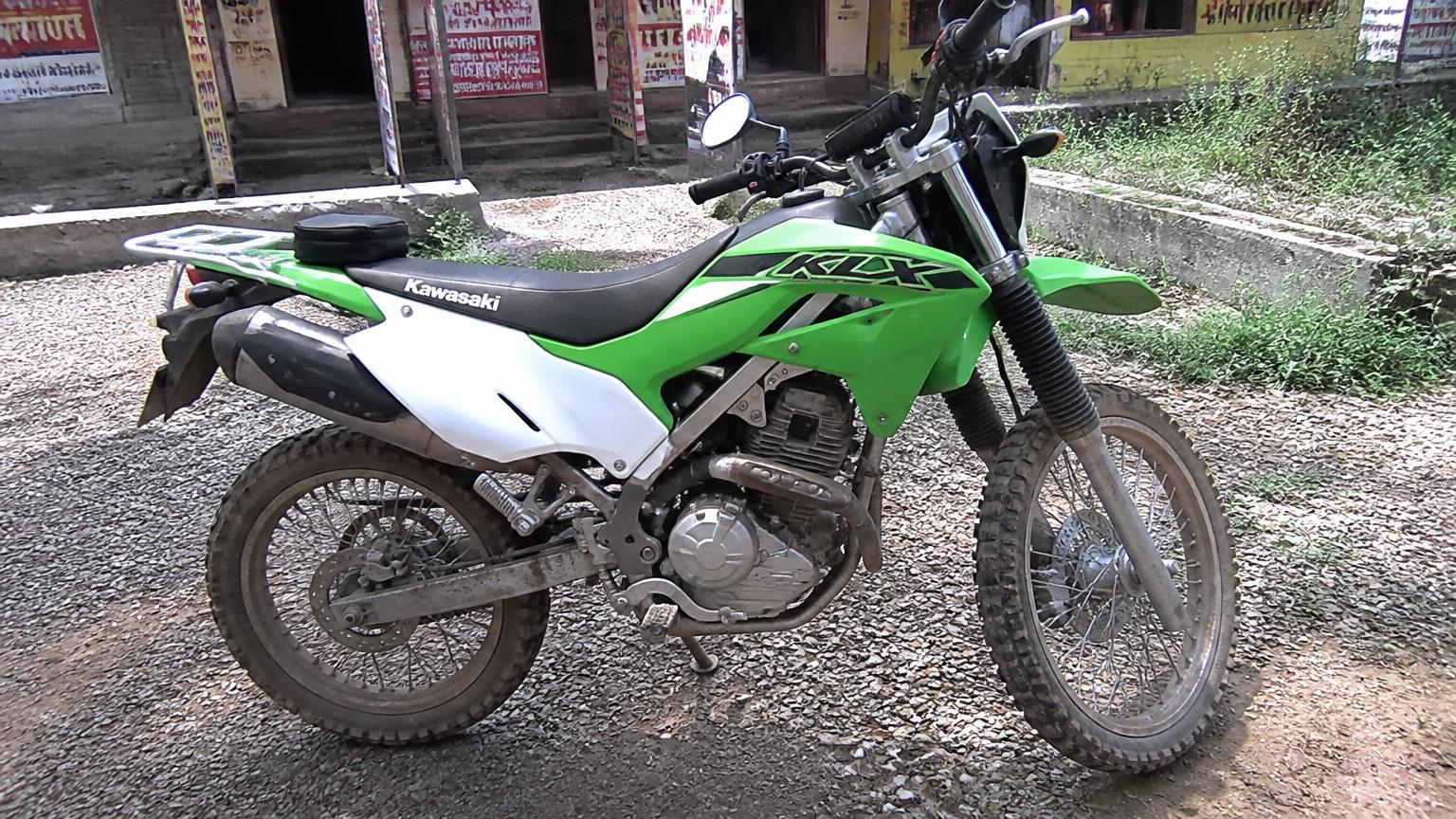
It looks like what it is - a dirt bike that has been made road legal. Slim tank, flat seat, high-mounted mudguard, 21-inch front and 18-inch rear spoked wheels, and enough ground clearance that speed breakers stop existing as a category of problem. There is not much equipment: a small digital display, dual-channel ABS, and that is broadly the list. Nothing on it feels cheap, but nothing on it feels expensive either.
When you're standing next to it in the showroom, do the boring checks. Run a finger along the panel gaps near the tank, click the switches a few times, and sit on it with the side stand up and both feet down. The measured 880 mm seat sounds fine on paper and then surprises people at a signal. At 134 kg, it felt easy enough to shove around, even if you're fairly new to bikes.
Engine and performance
The numbers: 233cc air-cooled single, fuel injected, 18.9 PS @ 7,600 rpm, 18.3 Nm @ 6,100 rpm, through a 6-speed, and it'll see about 120 kmph if you find the road for it. You won't. What actually matters here is what the bike does between 40 and 90 kmph, because that's where your entire riding life happens in this country.
Off road it is in a different league to anything else you can buy new in India at any sensible price. The Uni-Trak rear absorbs step-downs and rock beds without kicking, the light weight makes a technical climb feel like something you can attempt rather than survive, and the engine's soft low-end lets you crawl in first gear without the clutch abuse a bigger single demands. On tarmac the compromises show up quickly: 90-100 kmph is where it wants to live, the 7.6-litre tank means you are looking for petrol every 220-240 km, and there is no wind protection whatsoever.
Mileage worked out to 32-36 kmpl in mixed riding for me, with a 7.6 litres tank — so you can do the range maths yourself and plan fuel stops without drama. Fair warning: your right wrist decides this number far more than the brochure does. Ride it hard and 15-20% of that mileage quietly disappears.
Full technical specifications
Everything mechanical is in the table below. Short version: 37 mm telescopic front with 220 mm travel, uni-trak monoshock rear with 223 mm travel holding it up, and 240 mm front disc, 220 mm rear disc, dual-channel abs slowing it down. One opinion I won't budge on — if you ride in rain or unpredictable traffic, dual-channel ABS is worth whatever it costs. Single-channel only looks after the front wheel, and it's rarely the front that catches you out.
| Engine | 233cc air-cooled single, fuel injected |
|---|---|
| Max power | 18.9 PS @ 7,600 rpm |
| Max torque | 18.3 Nm @ 6,100 rpm |
| Gearbox | 6-speed |
| Top speed | 120 kmph |
| Mileage (real world) | 32-36 kmpl |
| Kerb weight | 134 kg |
| Fuel tank | 7.6 litres |
| Seat height | measured 880 mm |
| Brakes | 240 mm front disc, 220 mm rear disc, dual-channel ABS |
| Suspension | 37 mm telescopic front with 220 mm travel, Uni-Trak monoshock rear with 223 mm travel |
| Service cost | Rs 2,800-4,200 per service, every 5,000 km |
| Insurance | Rs 9,000-12,000 a year comprehensive |
| Resale outlook | Moderate - around 55-62% after three years, buyer pool is small |
EMI, down payment and the real cost of finance
Almost nobody pays cash for a bike, so let's do the loan maths. Put down 20% — ₹78,400 — borrow ₹3,13,600 at 9.5%, and you get the EMIs in the table and calculator below for 12, 24, 36 and 48 months.
Two things I tell everyone who asks. A longer tenure makes the EMI look friendly and quietly costs you thousands more in interest, so take the shortest one you can actually live with. And don't sign the dealer's finance form just because it's on the desk — a pre-approved offer from your own bank usually comes in 1-2 percentage points cheaper, and if you're salaried, the PSU banks are normally the best of the lot.
Keep ₹1,500-3,000 aside for processing fees, plus documentation charges and the five-year third-party insurance that's baked into the on-road price. Then read the quotation properly. Accessories you never asked for and an "extended warranty" you didn't agree to are the two lines I find padded most often.
| Tenure | Monthly EMI | Total interest |
|---|---|---|
| 12 months | ₹27,498 | ₹16,371 |
| 24 months | ₹14,399 | ₹31,971 |
| 36 months | ₹10,046 | ₹48,039 |
| 48 months | ₹7,879 | ₹64,574 |
Based on 20% down payment (₹78,400) and 9.5% annual interest.
EMI Calculator · Kawasaki KLX 230
Adjust the on-road price, down payment, interest rate and tenure to see your real monthly cost.
On-road price
₹3,92,000
Down payment
20% · ₹78,400
Interest rate
9.5% p.a.
Tenure
Monthly EMI
₹10,046
Loan amount
₹3,13,600
Total interest
₹48,039
Mileage, servicing and running cost
The expensive part. Kawasaki's dealer network is city-based and thin, services cost Rs 2,800-4,200 every 5,000 km, and insurance is close to double what the Xpulse costs. Parts are not the issue - most consumables are shared and reasonably priced - but you will drive further to get them fitted. I averaged 34 kmpl in mixed use. If you ride serious trails, add tyres at Rs 14,000-18,000 a pair every 8,000-10,000 km, because good knobblies do not last.
Servicing is Rs 2,800-4,200 per service, every 5,000 km, comprehensive insurance Rs 9,000-12,000 a year comprehensive. On top of that, tyres every 20,000-25,000 km, a chain and sprocket set around the same time if it's chain-driven, and brake pads once or twice a year if you're in city traffic all day.
The one number I'd actually compare bikes on is cost per kilometre. Take your fuel spend at 32-36 kmpl and today's petrol price, add a year of servicing and insurance, divide by however much you really ride. Do that for two or three bikes and the decision usually makes itself — no showroom pitch required.
How it compares with rivals
Against the Hero Xpulse 210 it is a better trail bike in every measurable way and costs Rs 1.8 lakh more on-road, which is a lot of money for the last 20% of capability. Against a KTM 250 Adventure it gives up highway pace and gains genuine off-road ability. Nothing else new sits in this space.
If you can, ride your shortlist on the same day, on the same road, wearing the same gear. Demo bikes are set up differently and your memory of yesterday's test ride is unreliable. Watch three things while you're at it: how heavy the clutch feels in traffic, whether the mirrors blur at 60 kmph, and how comfortably you can put both feet down at a signal. Those are the things that decide whether you still like the bike two years in.
New or used: which makes more sense
A three-year-old one goes for ₹2,35,000-₹2,95,000 against ₹3,92,000 on-road new. That's a lot of money for the same riding experience. Resale here is moderate - around 55-62% after three years, buyer pool is small, so if you buy used and sell in a couple of years, you lose very little in between.
Physically: check the date codes on the tyres, chain slack, fork seals for any oil weep, how much disc is left, and get your phone torch under the engine looking for leaks. Cycle all the electricals too — the ABS light should come on with the ignition and go off once you're rolling. Then take it for at least 5 km, and brake hard once from 50 kmph so you know what you're buying.
Paperwork, briefly: ₹500-1,500 for the RC transfer, insurance moved into your name within 14 days, and never pay the full amount before the transfer forms are signed and submitted. I've seen that go wrong more than once.
Who should buy it
Buy it if you ride trails often enough that capability outranks cost, and if you have the inseam for an 880 mm seat. If dirt is a twice-a-year plan, the Xpulse does 80% of this for less than half the money and is a far better bike for the 300 tarmac days in between. Sit on one before you commit - that seat height ends this conversation for a lot of riders.
If you're under about 5'6", go sit on it before you book anything — that measured 880 mm seat height is the single most common regret I hear. And if someone rides behind you every day, take them along on the test ride. Pillion comfort varies wildly between these bikes and no spec sheet will tell you that.
Final verdict
So why is the Kawasaki KLX 230 on this list? Mainly 134 kg kerb weight makes technical trails genuinely approachable and best-in-class suspension travel and damping quality. Its problems — 880 mm seat height rules it out for shorter riders, 7.6-litre tank means frequent fuel stops, kawasaki service network is thin outside major cities — are real, but you can see all of them from the showroom floor. Nothing here ambushes you six months later, which is more than I can say for some of its rivals.
₹3,92,000 on-road new, ₹2,35,000-₹2,95,000 used. Right bike for the rider I described above, wrong bike for most other people, and that's fine. Before you go anywhere, put your own down payment and tenure into the calculator above and hold that EMI against what's actually left in your account at month-end — not your salary. — Sneha Kulkarni, Nashik, Maharashtra
What we like
- 134 kg kerb weight makes technical trails genuinely approachable
- Best-in-class suspension travel and damping quality
- Dual-channel ABS with real off-road-friendly calibration
What we don't
- 880 mm seat height rules it out for shorter riders
- 7.6-litre tank means frequent fuel stops
- Kawasaki service network is thin outside major cities
Who rode it
Touring Correspondent · Nashik, Maharashtra
Has ridden Spiti twice and Kanyakumari once, mostly two-up, and judges every bike by how it feels on hour six.
- 80k+ Touring Km
- Two-Up Comfort Tests
- Himalaya Rides x2
How to buy it without getting talked into something
Follow this order. It is the same sequence I use myself, and it has saved friends more money than any amount of haggling on the showroom floor.
- 1Write down your real monthly kilometres. Everything below — mileage, EMI tenure, service interval — only makes sense against that one number.
- 2Ask two dealers for a written on-road quotation for the Kawasaki KLX 230 and compare them line by line. Insurance and accessories are where the padding hides.
- 3Book a test ride of at least 5 km, in traffic, at the time of day you actually ride. Check clutch weight, mirror vibration and how the measured 880 mm seat feels at a signal.
- 4Get a loan pre-approval from your own bank before you discuss finance at the showroom, then use the dealer offer only if it beats it.
- 5Put your down payment and tenure into the calculator on this page and check the EMI against your month-end balance, not your salary.
- 6If you are buying used, verify the RC, chassis and engine numbers, hypothecation status and Parivahan record before any money changes hands.
Frequently asked questions
What is the on-road price of the Kawasaki KLX 230 in India in 2026?
It is ₹3,37,000 ex-showroom and lands around ₹3,92,000 on-road in a metro city. Your final figure shifts with state road tax — Delhi is on the lower side at roughly 6%, Karnataka and Maharashtra are considerably higher — so the same bike can differ by ₹8,000–10,000 between two cities. Always ask for the quotation in writing with tax, insurance and handling shown separately.
What mileage does the Kawasaki KLX 230 really give?
I saw 32-36 kmpl in mixed riding — city traffic plus some open road — with a 7.6 litres tank. Ride it hard, keep the tyres underinflated or sit in stop-start traffic all day and you will lose 15–20% of that. Gentle throttle, correct tyre pressure and on-time servicing is genuinely worth several kilometres per litre.
What would the EMI be on the Kawasaki KLX 230?
With a 20% down payment of ₹78,400 and 9.5% annual interest, the EMI table on this page shows the exact monthly figure for 12, 24, 36 and 48 months. Longer tenures look comfortable and quietly cost thousands more in total interest, so pick the shortest tenure you can service without straining your month.
How much does it cost to run and service the Kawasaki KLX 230 every year?
Servicing works out to rs 2,800-4,200 per service, every 5,000 km and comprehensive insurance rs 9,000-12,000 a year comprehensive. Add tyres every 20,000–25,000 km, a chain and sprocket set around the same mark if it is chain-driven, and brake pads once or twice a year for heavy city use. Resale outlook is moderate - around 55-62% after three years, buyer pool is small, which matters if you plan to sell within three years.
Should I buy the Kawasaki KLX 230 new or second-hand?
If you ride under about 800 km a month, a three-year-old example at ₹2,35,000–₹2,95,000 is hard to argue against versus ₹3,92,000 on-road new. Buy new if you cover high distances, tour regularly, or cannot find a used example with a full service history — warranty is worth real money at high usage.
Reader poll
Would you buy the Kawasaki KLX 230?
Choose the answer closest to your current view.
77 readers have answered so far.
Reader comments
4.2 from 6 riders- MP
Manoj Pillai
Coimbatore ·
5.0Finally a review that talks about service cost and resale instead of just power figures. That's what actually decides things when you're spending your own money. Been riding mine for a year, still happy.
- SD
Sourav Das
Bhubaneswar ·
5.0Did Pune-Goa on it last month, two-up with soft luggage. Averaged around 65-70 kmph on the highway without feeling like I was thrashing it. Only thing I'd add to this review: get better grips, the stock ones numb your palms after 200 km.
Sneha KulkarniAuthorTouring Correspondent ·
Accha laga jaanke ki EMI table match hua, Sourav. Rate aadha point upar neeche hota rehta hai bank se bank, isliye do teen jagah compare karna banta hai.
- PN
Priya Nair
Kochi ·
4.0Waiting period at my dealer in the city is around five weeks, they wouldn't confirm anything on phone. Went in person, paid the token, got a proper date. Small tip for anyone reading — don't book online, you lose the room to negotiate.
Sneha KulkarniAuthorTouring Correspondent ·
Priya, your figures track with ours. On our own test runs the Kawasaki KLX 230 sits near the lower end of the claimed 32-36 kmpl in heavy traffic and climbs once you get a clear stretch. On the wet-weather grip point — we agree, and we say so in the review.
- MJ
Meenal Joshi
Indore ·
4.0Test rode this and two rivals on the same Sunday. This one felt the most sorted at city speeds. Seat is fine for me at 5'8", my wife says it's okay for an hour and then she starts asking how far the next chai stop is.
- SP
Sneha Patil
Nagpur ·
3.0Honest take from three months of ownership: it does everything decently and nothing brilliantly. If you're upgrading from a 150, you'll love it. If you already ride something bigger, you'll notice what's missing. The review is fair, I just wish the vibrations above 90 were mentioned louder.
Sneha KulkarniAuthorTouring Correspondent ·
Fair criticism, Sneha. We should have been louder about the vibrations past 90 on the Kawasaki KLX 230 — it's in the cons list but it deserves a full paragraph. Noted for the next revision.
- AK
Ayesha Khan
Lucknow ·
4.0Booked mine two months back. The on-road figure my dealer quoted was about ₹6,000 more than what's written here, mostly some accessory package I didn't ask for. Got it removed after arguing for twenty minutes, so definitely check the quotation line by line. Otherwise the Kawasaki KLX 230 has been exactly what I hoped for.
Sneha KulkarniAuthorTouring Correspondent ·
Wah Ayesha, teen bikes ek hi din mein test karna sabse sahi tareeka hai. Back-to-back ride mein hi asli farak samajh aata hai, spec sheet padhne se nahi.