
Buyer's guide · Practical ownership advice
Royal Enfield vs Jawa in 2026: the retro classic argument, settled honestly
I have owned a Classic 350 for four years and borrowed a Jawa 42 for long enough to stop being polite about it. Here is what actually separates them once the showroom lighting is gone.
Key takeaways
- On-road prices are near identical, roughly ₹2.05-2.45 lakh, so price is not the deciding factor here.
- Royal Enfield wins on service network reach, long-distance comfort and resale value; Jawa wins on styling and low-speed engine eagerness.
- Real mileage is 32-37 kmpl for both, and annual running cost lands within ₹1,500 of each other.
- Jawa depreciates roughly 10-13 percentage points harder over three years, which is ₹25,000-30,000 on this budget.
- Check the distance to your nearest authorised service centre for each brand before comparing anything else.
Two bikes that sell on feeling, not on spec sheets
Nobody walks into a showroom and buys a retro classic because of a torque figure. I certainly didn't. I bought my Classic 350 in 2022 because of the noise it made idling outside a tea stall in Lonavala, and I have spent the four years since defending that decision to people who own faster, cheaper, more sensible motorcycles.
That is the honest starting point for this comparison. Royal Enfield and Jawa both sell nostalgia, and both do it well. Where they differ is in what happens after the first month, when the neighbours have stopped looking and you are just a person who has to get to work and pay for servicing.
So this is not a brochure fight. This is what four years with one and three weeks with the other taught me, including the things I got wrong.
What you are actually buying in each case
Royal Enfield in 2026 is not the company that sold you a leaking bike in 2011. The J-series 350 engine, which sits in the Classic 350, Hunter 350, Bullet 350 and Meteor 350, is a genuinely well-sorted single — smooth to about 100 kmph, oil-tight, and boring in the way an engine should be boring. Prices run roughly ₹2.05 lakh to ₹2.45 lakh on-road for a Classic 350 depending on variant and city.
Jawa, built by Classic Legends, is the more interesting-looking of the two and it is not close. The 42 and the Perak have proportions and paint that make people cross a parking lot to ask what it is. The 294cc liquid-cooled single is a rev-happier, more modern-feeling engine than the Enfield's, and on-road pricing sits roughly ₹2.05 lakh to ₹2.35 lakh for a 42, so effectively the same money.
Same segment, same budget, same buyer. The split happens on refinement and on what your city's service situation looks like.
Riding them back to back
The Enfield feels heavier and slower, and both of those things turn out to be features. It settles into 80-90 kmph and just stays there, low-frequency thump coming through the pegs without ever becoming irritating. Two-up with luggage, on a bad state highway, it is unbothered. That is what the extra weight buys you.
The Jawa is livelier. It picks up faster below 60 kmph, it changes direction more willingly in traffic, and the exhaust note — twin pipes on the 42 — is sharper and, to my ear, more exciting for the first hour. It is the better bike to ride to a coffee place 20 km away.
Then hour three arrives and the ranking flips. The Jawa buzzes through the bars from about 95 kmph in a way the Enfield does not, and the seat gets hard sooner. On a 400 km day, I finished on the Classic 350 feeling fine and on the 42 feeling like I had been working. If your longest regular ride is 40 km, ignore this paragraph entirely. If you plan two-up trips to Goa, do not.
Braking and suspension are closer than people assume. Both get dual-channel ABS on current variants, both have front forks that feel underdamped over sharp expansion joints, and neither is a corner-carver. Nobody buying either of these should care much.
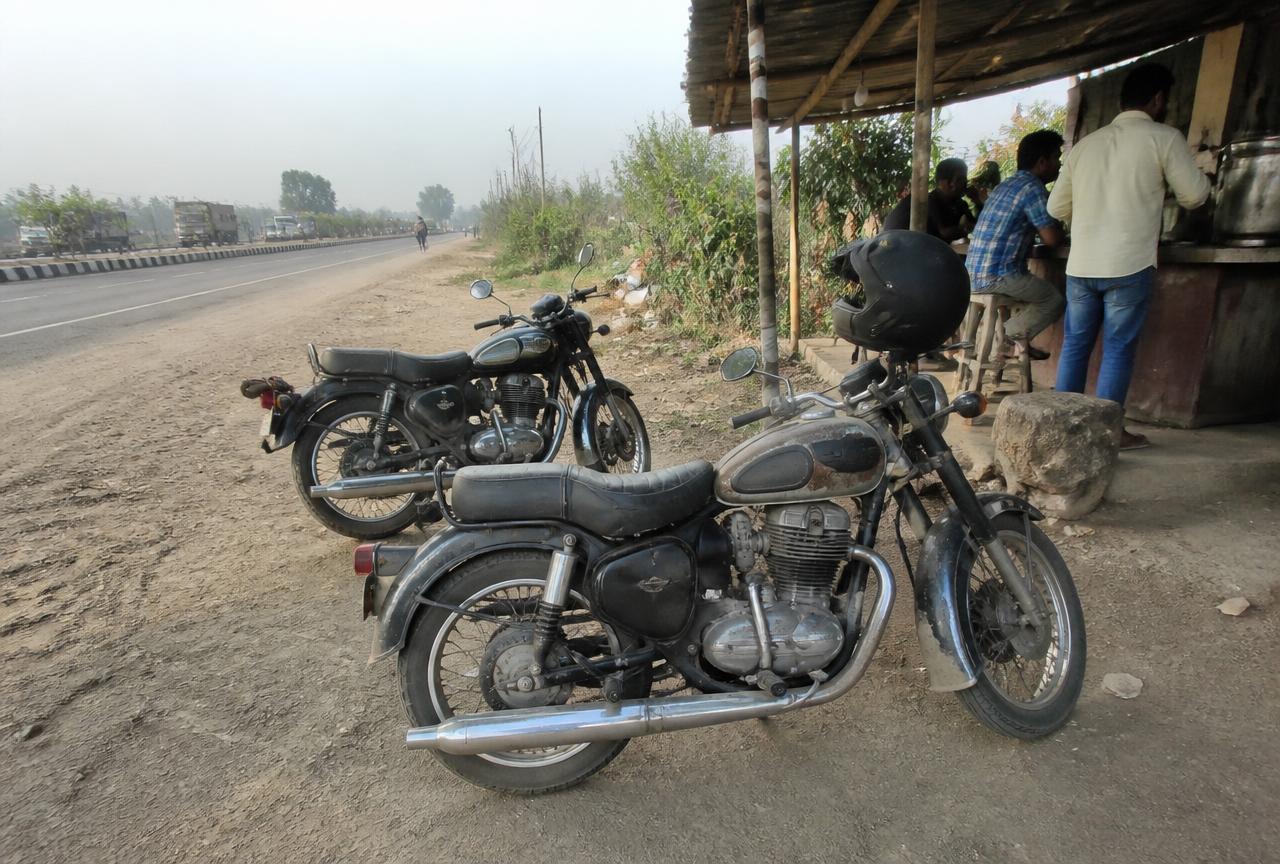
The part that decides it: service and spares
This is where I stop being even-handed. Royal Enfield has well over 2,000 touchpoints in India, and in most towns of any size you can walk in without an appointment. My Classic has needed a clutch cable, a set of pads and routine services in four years, and every single part was on the shelf the same day.
Jawa's network is real but thin, and thin means something specific in practice. A friend in Nagpur waited eleven days for a regulator-rectifier. Nothing dramatic broke — the bike just sat there. That is the risk you take, and it is not about build quality, it is about parts logistics.
So before you compare anything else, do this one boring thing: open Maps, find the nearest authorised service centre for each brand, and note the distance. If the Jawa dealer is 90 km away and the Enfield one is 6 km away, this comparison is already over regardless of which bike you like looking at more.
Running costs over three years
Fuel first. The Enfield 350 returns a real 33-37 kmpl in mixed riding; the Jawa 42 sits around 32-36 kmpl. At 800 km a month and ₹105 a litre, that is roughly ₹2,300-2,500 either way. Genuinely no difference worth writing about.
Servicing on the Enfield runs ₹1,600-2,400 per visit every 5,000 km, and consumables are cheap because volume makes them cheap. Jawa services cost broadly the same, ₹1,700-2,600, but individual parts tend to be pricier because fewer are sold. Insurance for both lands at ₹6,000-8,000 comprehensive.
Resale is the real money. A three-year-old Classic 350 in clean condition holds about 65-70% of what you paid. A three-year-old Jawa 42 holds closer to 52-58%, and it sells slowly because used buyers worry about parts. On a ₹2.2 lakh bike that gap is ₹25,000-30,000 of actual rupees you either keep or lose. Nobody mentions this at the showroom.
Where the Jawa genuinely wins
Two things, and both matter to some people more than money does.
Looks. The 42 and especially the Perak are the more distinctive motorcycles. In a country where every third bike at a traffic light is an Enfield, standing out is a legitimate reason to buy something. I have watched people ignore a Classic 350 and walk straight past it to look at a Perak.
Engine character. The 294cc liquid-cooled unit is more modern, revs more freely, and feels quicker in short bursts. If your riding is city-only and you want something that responds when you open the throttle, the Jawa is more fun below 70 kmph.
There is also a smaller point: Jawa dealers negotiate. Enfield dealers usually do not, because they do not need to. I have seen accessories, insurance and extended warranty thrown in on a Jawa deal worth ₹12,000-15,000. Ask.
How I would decide, in your shoes
First bike, or your only bike, and you ride 600 km-plus a month — Royal Enfield. The service network and the resale value are not exciting reasons, but they are the ones you will feel.
You already own something reliable and want a weekend character bike — Jawa, and enjoy it. When a second bike sits idle for a week waiting on a part, it is an inconvenience, not a crisis.
Regular two-up highway touring — Royal Enfield Classic 350 or a Meteor 350. Long-haul comfort is the Enfield's actual advantage, not the badge.
You are in a tier-2 or tier-3 town — check dealer distance first, then decide. In most such towns that answer will be Enfield by default.
You want to look at your own bike every morning and feel something — Jawa Perak, buy it, and budget ₹15,000 as a mental cushion for slower parts and weaker resale. Sometimes that is a fair price for liking your motorcycle.
The short version
- Royal Enfield is the safer buy for 2026 and the gap is mostly service reach and resale, not riding ability.
- Jawa is the better-looking motorcycle with the more eager engine, and it is genuinely worth considering as a second bike or in a city with a proper dealer.
- Expect to lose ₹25,000-30,000 more to depreciation over three years on the Jawa. Decide whether the styling is worth that to you — for some riders it honestly is.
- Whichever you pick, ride both for at least 30 minutes each, on a road you actually use, before signing anything.
Frequently asked questions
Is Jawa reliable compared to Royal Enfield in 2026?
Mechanically the current Jawa 294cc engine is sound, and the widely repeated quality complaints belong mostly to the 2019-2020 launch batch. The practical reliability gap today is about parts availability rather than parts failing - Royal Enfield has thousands of touchpoints and deep stock, so a small fault is a same-day fix, while a Jawa in a town without a nearby dealer can sit waiting a week or more for a component.
Which gives better mileage, Royal Enfield or Jawa?
They are close enough that it should not swing your decision. A Royal Enfield 350 returns about 33-37 kmpl in mixed riding and a Jawa 42 about 32-36 kmpl. Over 800 km a month that difference is well under ₹200, which is less than the variation you will see between your summer and monsoon riding anyway.
Does a Jawa hold its resale value?
Less well than a Royal Enfield. Expect roughly 52-58% of your purchase price after three years against 65-70% for a comparable Enfield, and expect the sale to take longer because used buyers are cautious about parts support. If you change bikes every two or three years, factor ₹25,000-30,000 of extra depreciation into the Jawa's price.
Which is more comfortable for long highway rides two-up?
The Royal Enfield, clearly. Its extra weight and lower-revving engine make 80-90 kmph cruising feel unstressed, and the seat holds up better past the two-hour mark. The Jawa transmits noticeable vibration through the bars above about 95 kmph and its saddle gets firm sooner, so it is happier on shorter city and weekend runs.
Can I negotiate the price on either bike?
On a Royal Enfield, rarely - demand is strong enough that dealers hold their price, though you can sometimes get accessories or a discounted extended warranty. Jawa dealers are far more flexible and regularly bundle insurance, accessories or accessory vouchers worth ₹12,000-15,000. Always ask for the on-road quotation as an itemised sheet and strike out anything you did not request.
Who wrote this
Senior Road Tester & Journalist · Pune, Maharashtra
Rode his first Splendor at 17, has since put over 2 lakh km on Indian roads and still refuses to review a bike he hasn't lived with for a week.
- 2 Lakh+ Km Tested
- Engine Specialist
- 14 Years Riding