
Buyer's guide · Practical ownership advice
New vs used bikes: where the money actually goes
I have bought and sold over 400 second-hand motorcycles. Here is the honest version of this argument, including the times I told a buyer to go pay full price at the showroom instead.
Key takeaways
- A bike loses 25-35% of its value in year one. Buying at three years old means someone else already paid for the steepest part of the curve.
- Add ₹6,000-15,000 to any used asking price for tyres, chain, battery and a catch-up service before you compare it with a new bike.
- Used bike loans typically run 14-18% against 9.5-11% for new, which can flip a close decision on monthly outgo.
- Service records beat low odometer readings every single time. A stamped book is worth paying 10-15% more for.
- Buy new if you ride over 1,500 km a month, tour often, or cannot find a documented used example you trust.
Why I stopped giving people a straight answer
For six years my Sundays were spent in the used two-wheeler market off Tank Bund in Hyderabad, buying bikes, cleaning them up, riding them for a week and selling them on. Somewhere around bike number ninety I stopped believing the line I used to repeat — that used is always the smarter buy. It isn't. It is usually the smarter buy, which is a very different sentence.
The reason people get this wrong is that they compare two price tags and stop there. A ₹1.8 lakh new bike next to the same model three years old at ₹1.05 lakh looks like an obvious ₹75,000 win. But you don't own a price tag, you own a machine for a few years, and the real comparison is what leaves your account every month until you sell it.
So let me walk you through it the way I would if you called me before going to look at something. No brand loyalty, no romance about carburettors.
Depreciation: the cost nobody writes down
Here is the thing that decides most of this argument. A mainstream Indian motorcycle loses roughly 15-20% of its value in year one, then about 8-10% a year after that. In plain numbers: a ₹1.8 lakh bike is worth around ₹1.45 lakh after twelve months. You paid ₹35,000 for the privilege of being the first owner and you will never see it again.
Buy that same bike at three years old and the steep part of the curve has already happened to somebody else. From year three to year five it might drop another ₹20,000 total. That is the entire case for used, and it is a strong one — you are buying the same riding experience minus the most expensive twelve months of its life.
But depreciation cuts both ways, and this is where I have watched people lose money. If you buy a used bike badly — wrong model, no service history, a segment nobody wants second-hand — you can absolutely lose ₹25,000 in a year on a ₹90,000 bike. Buying used protects you from depreciation only if you buy something the market still wants.
What used actually costs once it's yours
The number on the OLX ad is never the number you pay. Budget for RC transfer at ₹500-1,500 depending on state and whether you go through an agent, insurance moved into your name within fourteen days, and a fresh PUC. That is small money but it surprises people at the wrong moment.
Then the setting-right bill. Nearly every used bike I have bought needed something in the first month. Tyres, if the date codes are more than four years old — ₹4,000-6,000 a pair on a 150cc. Chain and sprocket set, ₹1,800-3,500. Battery, because they die around the four-year mark, ₹1,400-2,200. Fork seals if there is oil weeping down the tube, ₹1,200 with labour. Brake pads and a full oil-plus-filter service, another ₹1,500.
On a typical three-year-old commuter I plan for ₹6,000-8,000 of catching up. On a five-year-old 350 I plan for ₹12,000-15,000 and I am pleasantly surprised maybe one time in four. Add that to the asking price before you compare anything, because that is your real purchase cost.
And there is no warranty behind you. On a new bike a failed regulator-rectifier is a phone call. On a used one it is ₹2,500 out of your pocket on a Tuesday.
Where new quietly wins
Finance. This is the one almost everybody misses. Banks lend on new two-wheelers at 9-11% and will happily do 80% of the on-road value. On a used bike you are looking at 14-18% if a bank touches it at all, often on a shorter tenure, and many private financiers won't fund a vehicle older than five years. Run the numbers and a used bike bought on an expensive loan can end up costing more per month than a new one on a cheap loan. I have sat across from customers where exactly that happened.
Then the boring comforts. Two or three years of manufacturer warranty. Free first services. A known history instead of a story you are choosing to believe. And on newer bikes, real safety and emissions kit — dual-channel ABS, better lighting, OBD-2 compliance — that a 2016 bike simply does not have, no matter how clean the tank looks.
There is also a resale argument for new. First-owner bikes with a complete company service book sell faster and for ₹8,000-12,000 more than the same model on a second RC transfer. Buyers pay for a clean paper trail, and if you are the person who created it, you collect that premium later.
How much you ride changes the answer
Ask yourself what the bike is for, honestly, because usage flips this decision more than price does.
Under 400 km a month, mostly city — buy used, without hesitation. You will not put enough kilometres on it to reach the expensive wear items, and a well-kept three-year-old 125cc at ₹45,000-55,000 is the single best value in Indian motoring. Spend ₹6,000 setting it right and ride it for four years.
Around 800-1,200 km a month, daily commute — this is the fence, and it depends on service history rather than age. A used bike with a stamped book and one owner is still the better buy. A used bike with no records and 45,000 km on the clock will eat your savings in parts by month eight. If you cannot find the first kind, buy new and finance it cheaply.
Over 1,500 km a month, or you ride for a living — buy new. You are going to run through consumables so fast that warranty coverage and a predictable service schedule are worth more than the depreciation you avoided. Delivery riders who buy tired used bikes end up in the workshop instead of on the road, and lost earning days cost more than EMIs.
Long highway touring, two-up — new, or very lightly used from a single owner. Failures matter more when they happen 300 km from home, and that is worth paying for.
If you go used, this is my actual checklist
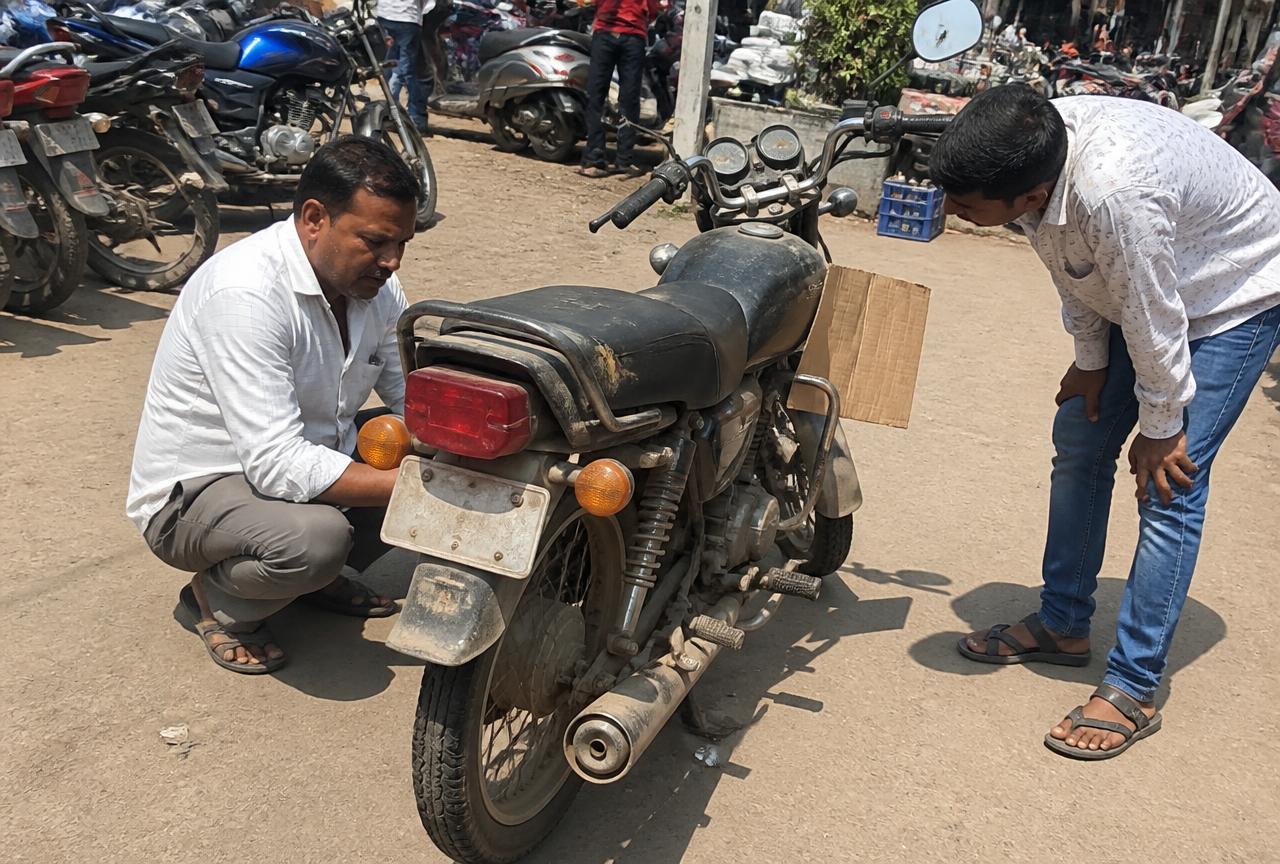
Insist on starting it stone cold yourself. If the engine is warm when you arrive, the seller is hiding a hard start, smoke on start-up, or a rattle that goes quiet once oil is circulating. I walk away from warm bikes now. It is the single most reliable filter I have.
Match the chassis and engine numbers to the RC in your hand, check there is no hypothecation still showing, and run the registration through the Parivahan site on your phone while you are standing there. Two minutes, and it tells you about accident-related blacklisting, RC status and insurance validity.
Look at the bike physically in this order: tyre date codes, chain slack and rust, fork tubes for oil, disc thickness, torch under the engine for weeps, then cycle every electrical switch. The ABS light should come on with the ignition and go off once you roll. Uneven paint texture or overspray on the black bits means a repaint, and a repaint usually means a fall.
Ride it at least 5 km, get to third and fourth gear, and brake hard once from 50 kmph. And never — genuinely never — pay the full amount before the transfer forms are signed and submitted. I have seen that go wrong twice, and both times to careful people.
The short version
- For low-usage city riders, a well-documented three-year-old bike is the best value in the market. The first owner already paid for the expensive year.
- Add ₹6,000-15,000 to any used asking price for tyres, chain, battery and a catch-up service. That is your real cost, and it decides close comparisons.
- If you need finance, compare the interest rates before the price tags. A 16% used loan can cost more monthly than a 9.5% new one.
- Buy new if you ride over 1,500 km a month, tour long distances, or cannot find a used example with genuine service records. Warranty is worth real money at high usage.
- Whichever way you go, check the papers before the paint. A beautiful bike with a bad RC is not a bargain, it is a problem you paid for.
Frequently asked questions
How much does a new bike depreciate in the first year?
Between 25% and 35% of the on-road price for most mainstream models, and the on-road price is the honest starting point because road tax and insurance are not recoverable. A ₹1.4 lakh commuter is typically a ₹1 lakh bike within twelve months. Royal Enfields and a few Honda models hold value better; anything with a thin service network falls faster.
What is the safest age to buy a used bike?
Three to five years old is the sweet spot. The heavy depreciation is done, the bike is still mechanically fresh if it was serviced, and spares and service knowledge are still easy to find. Beyond eight years you start paying in workshop visits what you saved on the purchase.
How do I verify a used bike's paperwork in India?
Match the RC against the chassis and engine numbers physically stamped on the bike, confirm there is no hypothecation still showing, check the insurance and PUC dates, and run the registration number through the Parivahan portal for ownership count and any pending challans. Never pay the full amount before the transfer forms are signed and submitted.
Is it cheaper to finance a used bike or a new one?
The loan is usually cheaper on a new bike because lenders price used-vehicle risk at 14-18%. On a smaller used principal that can still work out lower in total rupees, but check the monthly figure both ways - buyers regularly find a ₹75,000 used loan costs a similar EMI to a ₹1.2 lakh new one.
What should I inspect before buying second-hand?
Start the engine cold yourself, check tyre date codes, chain slack, fork seals for oil weep, remaining disc thickness and any leaks under the engine with a torch. Cycle every electrical item, confirm the ABS light behaves, then ride at least 5 km and brake hard once from 50 kmph. If the seller resists any of that, walk away.
Who wrote this

Used Bikes Editor · Hyderabad, Telangana
Spent six years buying and flipping second-hand motorcycles before writing about them. Can spot a repainted tank from across a parking lot.
- 400+ Used Bikes Inspected
- Resale Value Analyst
- Frame & Paint Checks