
Buyer's guide · Running costs
Buying your first bike in your early 20s without wrecking your money
I bought mine at 22 with ₹9,000 in the bank and learnt everything the expensive way. Here is the plan I wish somebody had handed me before I signed anything.
Key takeaways
- Keep the bike EMI under 15% of your take-home pay, and total bike costs under 25%.
- Budget the on-road price plus another 12% for helmet, gear, first services and fees.
- Aim for a 30% down payment and a 24-36 month tenure — never 48 or 60 months.
- Match the bike to your real daily riding for the next three years, not to your wish list.
- Under ₹80,000, a well-inspected used commuter beats a bare-bones new bike.
My first bike cost me twice what the sticker said
I was 22, six months into my first job in Pune, taking home ₹24,000 a month. I walked into a showroom on a Saturday to "just have a look" and rode out on Tuesday with a 160cc bike, a 36-month loan and a very cheerful salesman's phone number saved in my contacts.
The bike was fine. My planning was terrible. Nobody told me that the ₹1.32 lakh on the price board was not the number I would actually live with. Between insurance, the loan processing fee, a helmet I bought because the free one was a joke, and the first two services, I spent close to ₹1.6 lakh in year one on a bike I had budgeted ₹1.3 lakh for. For eight months I ate at home not by choice.
So this is not a lecture. This is the checklist I built afterwards, tested on three friends who bought their first bikes since, and it has held up every time. If you are in your early 20s and about to do this, read it slowly. It will take you fifteen minutes and probably save you ₹20,000.
Step 1: work out how much bike your salary can actually carry
Forget the bike for a minute. Take your monthly take-home pay — the amount that lands in your account, not the CTC on your offer letter. Two rules keep first-time buyers out of trouble, and I have not seen either one fail.
First, the EMI on the bike stays under 15% of take-home. On ₹25,000 that is ₹3,750 a month, which comfortably covers a 125cc commuter on a three-year loan and gets tight on anything above 160cc. Second, the whole cost of running the bike — EMI, fuel, servicing, insurance set aside monthly — stays under 25% of take-home. That second number is the one people never calculate, and it is the one that quietly ruins months.
If the bike you have been staring at on Instagram does not fit inside those two numbers, you have three honest options: save longer for a bigger down payment, drop one segment down, or wait for your next appraisal. Stretching the tenure to five years to force the EMI down is not a fourth option, it is the same mistake wearing a disguise.
Step 2: budget for the real on-road number, not the ex-showroom one
The price you see in an ad is ex-showroom. What you pay is on-road, and the gap is bigger than most people expect. On a ₹1 lakh ex-showroom commuter, expect road tax, registration, insurance and handling charges to add roughly ₹12,000 to ₹18,000 depending on your state.
Then there is the first-year stuff nobody puts on the board:
• A helmet you will actually wear: ₹2,500-4,500 for an ISI-marked full-face. The free showroom helmet is a formality, not protection. • Riding gloves and a cheap rain jacket: ₹1,500-2,500. You will use both more than you think. • Two services in the first year: ₹1,400-2,200 total on a commuter. • Loan processing and documentation fee: ₹1,500-3,500, and yes, it is negotiable. • A number-plate and accessory bill the dealer will try to inflate: say no to the seat cover, crash guard and "engine guard package" on day one. Buy them later if you actually miss them.
Add it up honestly before you fall in love with a model. My rule for anyone in their first job: whatever the on-road price is, keep another 12% aside in your account. If you cannot, you are not ready this month — and that is a completely normal place to be at 22.
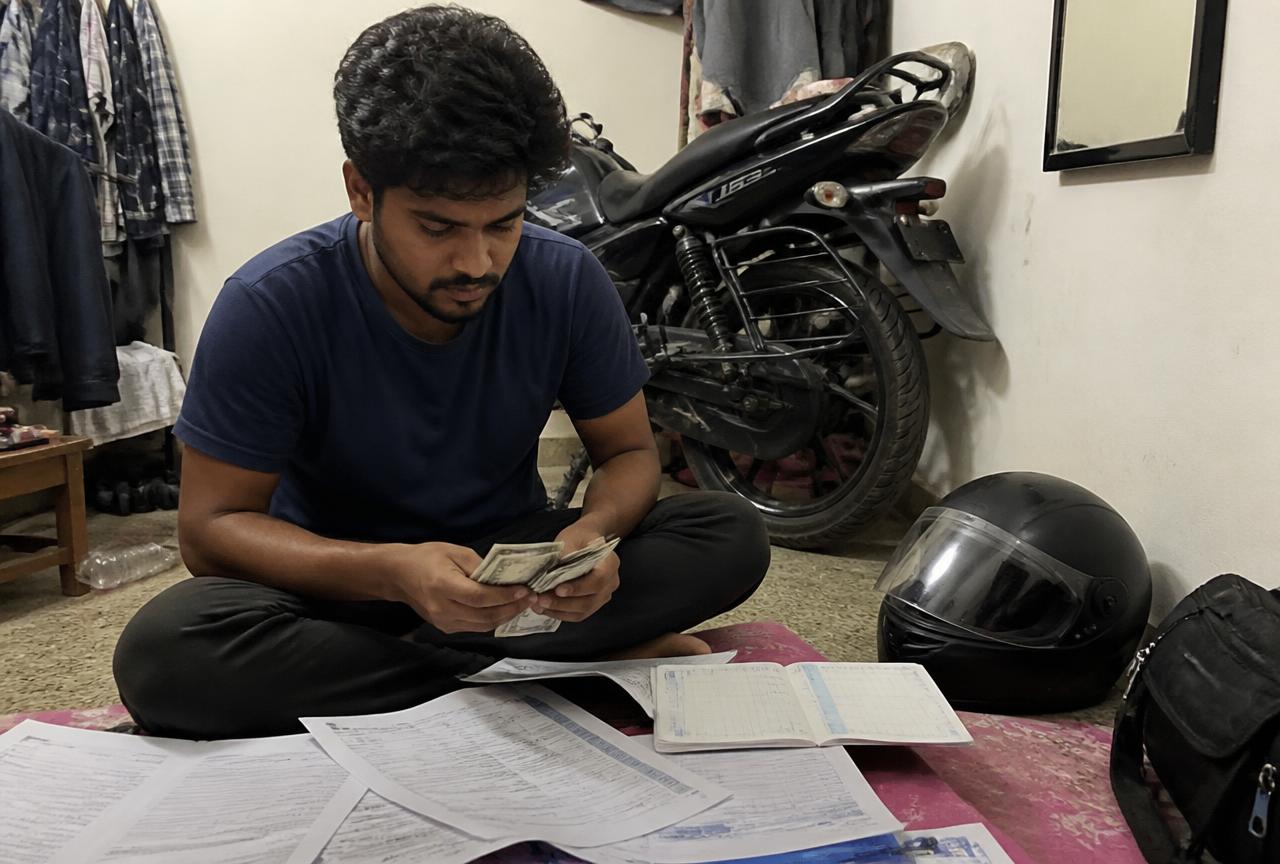
Step 3: down payment is where you win or lose the loan
Dealers love a small down payment because it makes the EMI look sweet and the interest look invisible. You want the opposite. Put down at least 30% of the on-road price if you possibly can, and keep the tenure at 24 or 36 months, never 48 or 60.
Take a ₹1.2 lakh on-road commuter at 11% interest. Borrow ₹1 lakh over 36 months and the EMI is around ₹3,270 with roughly ₹18,000 paid in interest. Borrow ₹84,000 over 24 months instead and the EMI is about ₹3,920 with only ₹10,000 in interest. Yes, the monthly is higher. You keep ₹8,000 that would otherwise have gone to a bank, and you own the bike outright a year earlier — which matters a lot when you switch jobs or cities, and in your 20s you will.
One more thing about down payment: do not empty your savings to make it. Keep at least one month of expenses untouched. A bike loan with zero buffer behind it is how people end up borrowing from friends for a service bill.
Step 4: pick the bike for your next three years, not for the group chat
This is the part where I lost the most money, so let me be blunt. At 22 I wanted something that sounded serious at a traffic light. What I actually did with the bike, every single day, was 14 km of stop-go office commute and a grocery run on Sunday. A 125cc commuter would have done that better, cheaper and with a saddle I could afford to service.
Write down what your riding really looks like for the next three years. Daily distance, mostly city or mostly highway, pillion often or rarely, parking situation, whether you will ride home to your parents' town on holidays. Then match a segment to that, in this order:
1. Under 15 km a day, city only, tight budget — a 100-125cc commuter. Cheapest to run, cheapest to insure, easiest to sell. 2. 15-40 km a day with some highway — a 150-160cc bike. Enough legs for a 70-80 kmph cruise without screaming. 3. Long weekend rides, 300+ km trips — a 250-350cc. Genuinely nicer, but the tyres, chain and insurance bills all step up with it.
And be honest about the small stuff: seat height if you are shorter, service centre distance from your house, spare-part availability in your city. A brilliant bike with the nearest service centre 40 km away becomes a bad bike by month four.
Step 5: new or used for a first bike?
If your total budget is under about ₹80,000, a well-kept used commuter beats a stripped-down new one nearly every time. The first owner has already absorbed the worst of the depreciation, and a ₹70,000 used 150cc is usually a better machine than a ₹70,000 new 100cc.
But used only works if you check properly. Insist on the original RC and the service book, check that the chassis number matches the papers, look for chain slack and fork oil weeping, and take it for a 10-minute ride including one cold start. Pay ₹500 to a mechanic you trust to look it over. That ₹500 is the highest-return money in this entire article.
If you have never owned a bike and have nobody around who can judge a used one, buying new with a warranty is a perfectly reasonable way to pay for peace of mind. Just do it on a 24-36 month loan and a fair down payment, and buy one segment below what your ego wants.
Step 6: the boring habits that keep the bike cheap
Own-damage insurance in year one is worth it, especially if you park on the road. Third-party alone covers the other guy, not your bike. Renew before it lapses — a lapsed policy resets your no-claim bonus and that is free money thrown away.
Service on schedule, not when something rattles. Chain cleaned and lubed every 500-800 km, tyre pressure checked once a fortnight, and air filter changed on time. These three habits are the difference between a bike returning 55 kmpl and the same bike returning 45.
Set aside ₹800 a month in a separate place for bike upkeep. Some months you spend nothing, then a tyre goes and you do not have to panic or borrow. This one habit changed my relationship with the bike more than any accessory.
The mistakes I see first-time buyers repeat
• Signing on a Saturday. Showrooms are crowded, salespeople are rushed, and you agree to the accessory package just to get out. Go on a weekday morning. • Only asking about the EMI. Always ask for the interest rate, the tenure, the processing fee and the total amount payable. If someone dodges those, walk. • Buying because a friend bought. Your commute is not his commute. • Skipping the test ride, or taking a 200-metre one in the parking lot. Ask for 10 minutes in traffic. • Loading up on chrome and stickers in month one. It adds nothing to resale and often reduces it.
None of this needs you to be good with money. It needs you to be slightly slower than the showroom wants you to be. That is the whole trick.
The short version
- First job, city commute, tight budget: a 100-125cc commuter on a 24-month loan is the least stressful money decision you will make this year.
- Mixed city and highway, salary above ₹35,000: a 150-160cc bike fits comfortably if you put down 30% upfront.
- If nothing fits inside 15% of take-home, wait two or three months and build the down payment instead of stretching the tenure.
- Spend ₹500 on a mechanic's inspection before buying used, and ₹3,000 on a helmet you will actually wear. Both pay for themselves.
Frequently asked questions
What is a realistic first-bike budget on a ₹25,000 monthly salary?
Around ₹90,000 to ₹1.1 lakh on-road, assuming you can put down ₹30,000-35,000 and keep the EMI near ₹3,000-3,500 on a 24-36 month loan. That lands you comfortably in the 110-125cc commuter space, which is exactly where a first bike should be if your riding is mostly city.
Can I get a bike loan at 22 with no credit history?
Usually yes. Lenders working with dealerships approve first-time borrowers on salary slips and bank statements, typically asking for three months of salary credits. Expect a slightly higher rate — often 11-14% — and a larger down payment demand. Paying these EMIs on time is also the cheapest way to build a credit score for later.
Should I buy new or used as my very first bike?
Under roughly ₹80,000 of total budget, used wins because someone else already paid the depreciation. Above that, new is fine and gives you a warranty, which matters if you have nobody to help you judge a second-hand machine. Either way, get any used bike checked by a mechanic before paying.
How much does a 125cc commuter actually cost to run each month?
For about 800 km a month, budget roughly ₹1,500 in fuel, ₹150-200 averaged out for servicing, and ₹200 set aside monthly for insurance and wear items. Call it ₹1,900-2,100 a month before the EMI. Add that to your EMI before deciding what you can afford.
Is a five-year loan ever a good idea for a first bike?
Almost never. A 60-month tenure on a two-wheeler means you pay a large chunk of the bike's value in interest and stay in negative equity for years, so selling or upgrading becomes painful. If a bike only fits your budget over five years, it is the wrong bike for right now.
Who wrote this

Senior Road Tester & Journalist · Pune, Maharashtra
Rode his first Splendor at 17, has since put over 2 lakh km on Indian roads and still refuses to review a bike he hasn't lived with for a week.
- 2 Lakh+ Km Tested
- Engine Specialist
- 14 Years Riding