
Buyer's guide · Practical ownership advice
Electric bikes vs E20 petrol bikes: which one actually saves you money?
I ran the numbers the boring way — on my own riding, my own electricity bill, my own petrol receipts. The answer depends almost entirely on how much you ride.
Key takeaways
- Your monthly kilometre count, not the vehicle type, decides which option is cheaper for you.
- E20 petrol costs most riders roughly 3-5% in mileage on older engines; on newer E20-ready engines the drop is small enough to ignore.
- Electric running cost lands around 25-40 paise per km at home tariffs, against roughly ₹2-2.60 per km on petrol.
- Electric bikes cost more upfront and save on fuel and servicing; the break-even usually arrives somewhere between 15,000 and 30,000 km.
- No home or workplace charging point means the maths stops working, however good the vehicle is.
The question everybody asks me at family functions
Ever since petrol pumps across India switched over to E20 — that is, petrol blended with up to 20% ethanol — I have been getting the same message roughly twice a week. Usually late at night, usually from a cousin. "Bhai, mileage gir gaya hai. Should I just buy an electric scooter or bike now?"
It is a fair question and it deserves a better answer than the two you normally get. One camp swears electric is free to run and petrol is dead. The other camp swears the battery will die in three years and you will be left holding a very expensive paperweight. Both are exaggerating, and neither of them has looked at your riding pattern, which is the only thing that actually decides this.
So let me do what I did at the dealership finance desk for six years: forget the brochures, open a spreadsheet, and see where the money actually goes. Before that, one thing needs saying, and I will keep repeating it through this piece — the honest answer is not "electric" or "petrol". The honest answer is a distance. Find out how many kilometres you ride in a month and the decision makes itself.
What E20 changed, and what it didn't
Ethanol carries less energy per litre than petrol does. That is not an opinion, that is chemistry. So when your pump switched to a 20% blend, your bike began burning slightly more fuel for the same distance. Real-world drop on most 100-160cc bikes I have tracked sits somewhere between 3% and 6%. On older carburetted bikes it can feel worse, closer to 6-8%, because the fuelling was never mapped for it.
Here is the part people miss: E20 did not make petrol bikes bad. A Splendor doing 60 kmpl instead of 64 kmpl is still a stupidly cheap way to travel. What E20 did was quietly shave a little off the one advantage petrol commuters were bragging about, and it arrived at exactly the moment electric two-wheelers finally got decent range and a real service network.
The other thing E20 did was make people nervous about rubber seals and fuel lines in older bikes. If your bike is BS6, relax, it is built for the blend. If it is a pre-2010 machine you ride daily, budget for a fuel line and seal check at your next service. That is a few hundred rupees, not a reason to change vehicles.
The petrol side of the ledger
Let me use a bike almost everyone recognises: a 110-125cc commuter, on-road roughly ₹90,000, and let us be realistic and say it now returns 55 kmpl on E20 in mixed city riding rather than the 60 it managed before. At ₹105 a litre, that is about ₹1.91 per kilometre in fuel alone.
Then add the boring stuff nobody puts in their calculation. Service every 4,000-5,000 km at ₹700-1,100 a visit, so call it around ₹0.20 per km averaged out. Engine oil, chain, brake pads, air filter — a commuter ridden hard chews through maybe ₹3,000-4,000 a year in wear items. Insurance for a bike this size runs ₹1,800-3,500 depending on whether you took own-damage cover.
Round it all up honestly and a petrol commuter costs you somewhere near ₹2.25 to ₹2.40 per kilometre, all in, excluding depreciation. That is the number to hold in your head.
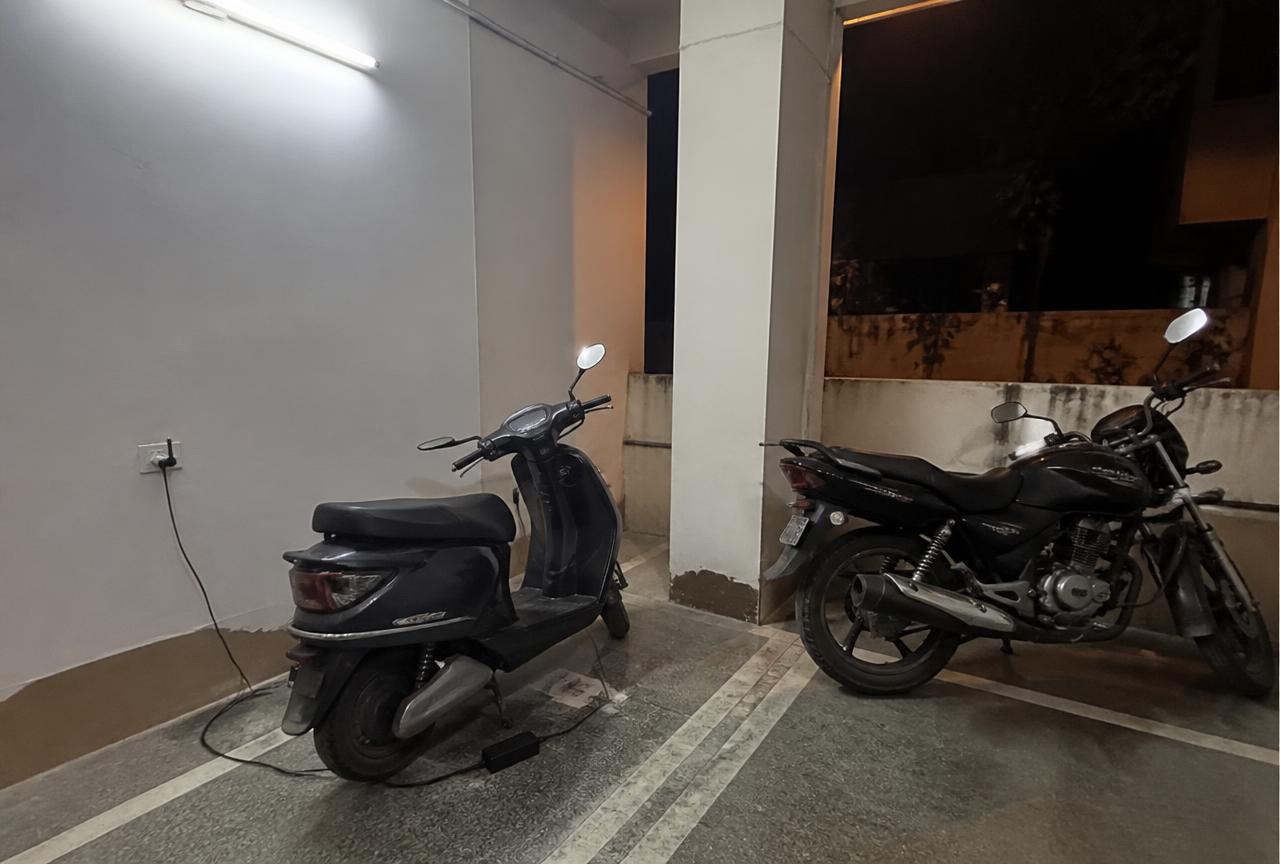
The electric side of the ledger
Take a comparable electric commuter — a decent 2.5 to 3 kWh scooter or motorcycle, on-road ₹1.25 to ₹1.45 lakh depending on state subsidy and city. That is a real ₹35,000 to ₹50,000 more than the petrol bike up front, and pretending otherwise is how people end up disappointed.
Charging is where it earns that back. A 3 kWh pack costs roughly ₹8 a unit on a domestic slab, so about ₹24 for a full charge, and realistically it gives you 75-85 km in city use once you account for a heavy right wrist and a pillion. That works out to roughly ₹0.30 per kilometre. Yes, really. It is that lopsided.
Servicing is genuinely cheaper because there is so little to service — no oil, no clutch plates, no chain if it is belt driven, brake pads that last longer thanks to regenerative braking. Budget ₹800-1,500 a year plus tyres. Insurance is broadly similar to petrol, sometimes slightly higher because the vehicle's insured value is higher.
Add it up and you are at roughly ₹0.55 to ₹0.70 per kilometre. Against ₹2.30-odd for petrol, you are saving about ₹1.60 every kilometre you ride.
So here is your actual answer: how much will you ride?
This is the bit I want you to take away, because everything above is just arithmetic serving this one question. Be honest about your monthly kilometres — not what you hope to ride on weekends, what your odometer actually adds up in a boring month.
Under 300 km a month — roughly 10 km a day, a market run, a school drop, occasional office. You will save about ₹480 a month. On a ₹45,000 price premium, break-even lands somewhere past seven years, which is longer than most people keep a commuter. Buy the petrol bike. Genuinely. Buy the petrol bike, put the saved money in an FD, and stop reading comparison articles.
500 to 800 km a month — the classic Indian office commute, 20-30 km a day both ways. You save ₹800 to ₹1,300 a month, and break-even arrives in roughly three to four and a half years. This is the fence. If you charge at home and your commute is predictable, electric wins comfortably. If you park on the street with no plug point, petrol still makes more sense however good the maths looks.
Over 1,000 km a month — food delivery, sales rounds, a genuinely long commute, or you are just one of those people who rides everywhere. You save ₹1,600 or more every month and you break even inside two to two and a half years. At this usage the argument is over. Electric, and you will feel the difference in your wallet by the third month.
Over 1,500 km a month with regular 150 km-plus single stretches — this is the one exception at the top end. Charge stops start eating your day, and a petrol bike with a 12-litre tank and a pump every 40 km is simply a better tool. Highway-heavy riders stay petrol for now.
The things that don't show up in a spreadsheet
Battery replacement. This is the fear, and it is not baseless — a pack replacement out of warranty is ₹40,000 to ₹60,000 on most mainstream models. But warranties now run 3 years or 30,000-40,000 km on the battery from serious manufacturers, and the packs that are actually failing early are largely from brands that cut corners on thermal management. Buy from a company with service centres in your city and this risk shrinks a lot.
Resale. Petrol commuters have three decades of resale data behind them and hold value predictably. Electric two-wheeler resale is still finding its feet, and buyers discount hard because they cannot verify battery health. If you flip vehicles every two years, that uncertainty can quietly erase your fuel savings.
Charging reality. A plug point where you park is not a detail, it is the whole business case. Riders who depend on public chargers or carry a battery up three floors every night tend to sell within a year, whatever the running cost said.
And the small pleasant surprise: no clutch, no gears, no vibration at a signal, no engine heat cooking your right calf in May traffic. Nobody buys a commuter for joy, but the first month on an electric in city traffic does something nice to your temper.
The short version
- If you ride under 300 km a month, a modern E20-compatible petrol commuter is still the cheaper vehicle over your ownership period, mileage dip and all. Buy it without guilt.
- If you ride 500-1,000 km a month and can charge where you park, electric is the better financial decision and the difference is real money, not marketing.
- If you ride over 1,000 km a month in the city, electric wins outright. If those kilometres are on highways, stay petrol until charging gets faster.
- Whatever you pick, write down your real monthly kilometres first. That single number decides this comparison far more than any spec sheet does.
Frequently asked questions
Does E20 petrol really reduce my bike's mileage?
On engines built before E20 compliance, yes - most riders report a 3-5% drop, and a few older carburetted bikes lose slightly more because ethanol carries less energy per litre than petrol. On a modern E20-ready fuel-injected engine the difference is usually within the range you would see anyway between summer and monsoon riding. If your mileage fell 15% overnight, blame tyre pressure, a choked air filter or a missed service before you blame the fuel.
How much does it cost to charge an electric bike at home in India?
A typical 3 kWh battery needs about 3.3 kWh from the wall after charging losses. At a domestic slab of ₹7-8 per unit that is roughly ₹23-26 for 80-100 km of real range, so 25-40 paise per kilometre. Public fast chargers cost two to three times that, which is why home or office charging is the whole basis of the electric cost advantage.
Will the battery need replacing in three years?
Modern lithium packs from established brands are warrantied for three years or 30,000-40,000 km and generally hold 75-80% of their original capacity well past that. The realistic outcome is not sudden death but slow range loss. Budget for a replacement somewhere around year six or seven, keep it out of full sun, and avoid sitting at 100% charge for days on end.
Is an electric bike a good idea for highway touring?
Not yet, for most people. Sustained 80-90 kmph speeds cut real range by a third or more, and charging stops of 40-60 minutes every 90 km turn a five-hour ride into a nine-hour one. If a meaningful share of your riding is intercity, a petrol bike remains the practical choice today.
What is the break-even distance between electric and petrol?
Take the upfront price difference and divide it by your saving per kilometre, which is usually ₹1.60-2.20 including lower servicing. A ₹40,000 premium at ₹1.80 saved per km breaks even at about 22,000 km. Ride 1,000 km a month and you are ahead in under two years; ride 250 km a month and it takes seven, by which point the battery worry becomes real.
Who wrote this

Finance & Ownership Cost Writer · New Delhi, Delhi
Ex-dealership finance desk, so he reads on-road quotations line by line and usually finds something that shouldn't be there.
- EMI & Loan Specialist
- 1,200+ Quotes Audited
- Insurance Deep Dives